
Robert D. Palmer Legacy Archive
Turning fragmented, conflicting historical material into a structured, evidence-first digital archive.
- Role
- Research, information architecture, UX strategy, content organization, content design, project direction, and implementation.
- Tools
- Next.js (App Router), TypeScript, Tailwind CSS, Vercel, GitHub, Resend (later Gmail SMTP for forms), Zod
- Timeline
- Not documented
Disclosure
Robert D. Palmer was my father. I met him in 2018, after nearly four decades apart, and we had a little over two years together before he died on December 31, 2020. During that time I recorded conversations with him about his life and career. Those recordings became the earliest material in what is now this archive.
This was a self-initiated project: no client, no brief, no deadline other than the ones I set for myself.
The personal relationship raised the emotional stakes. It also made disciplined evidence handling more important, not less. It would have been easy to let memory and hope stand in for verification. The archive's rule is that they don't.
The Situation
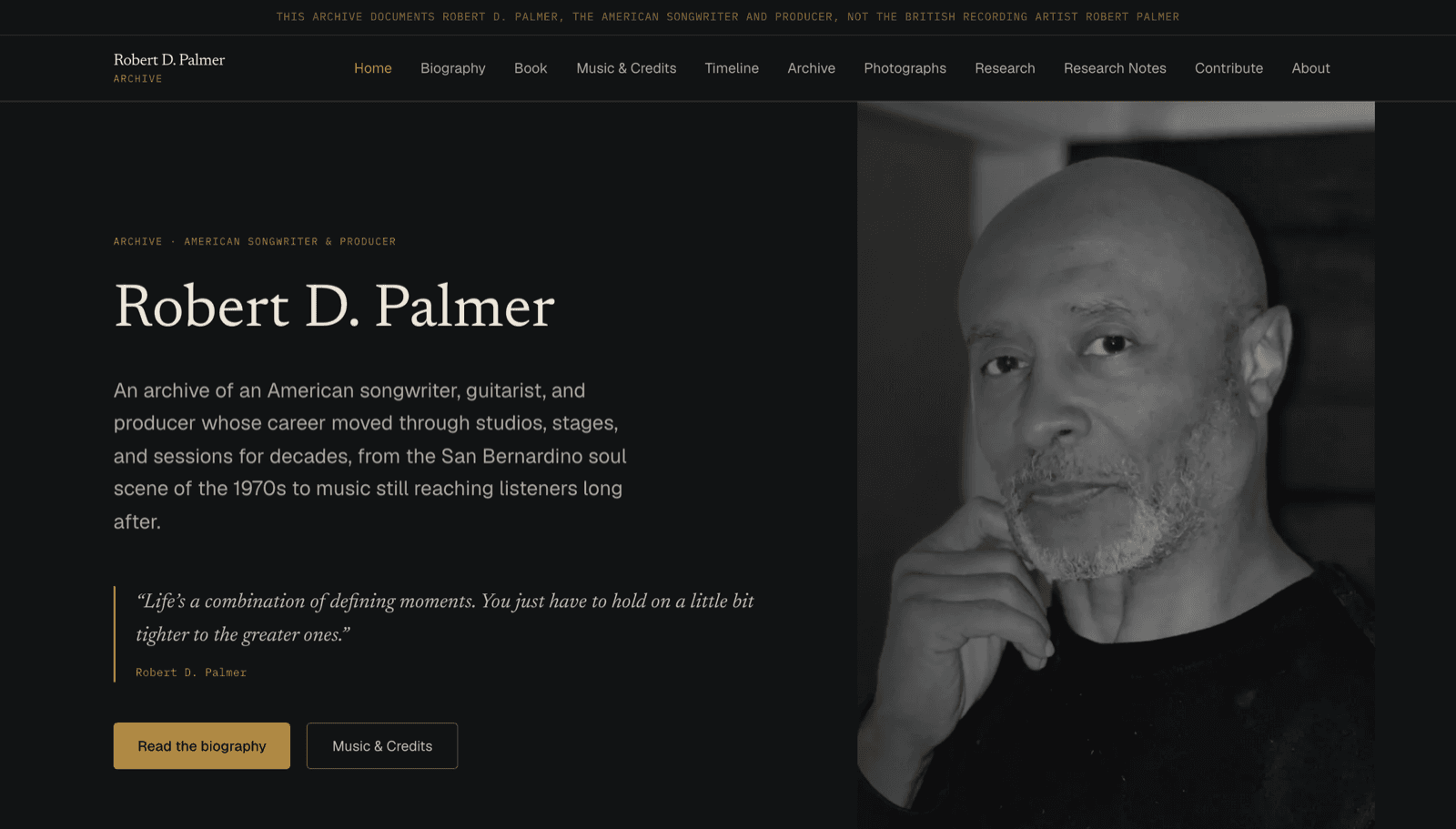
Robert D. Palmer was a songwriter, guitarist, and producer whose work ran from the San Bernardino soul scene of the 1970s through session and production work into the 2000s, including a Grammy-nominated songwriting credit on "Stickwitu" by The Pussycat Dolls. He died on December 31, 2020.
After he died, I found that his documented career had never been assembled into one place. It was scattered across credit databases, copyright and royalty records, trade publications, newspaper archives, television listings, release credits, recordings, photographs, and the memories of people who had worked with him. No one had collected it, and pieces of it were at risk of disappearing for good.
The Robert D. Palmer Legacy Archive is the permanent public record built to hold that material together.
The Central Tension
The record was incomplete and, in places, contradictory. A family account might place him at a session; a public database might credit a different person entirely; a royalty statement might confirm a composition with no evidence of how, or whether, it was ever recorded.
The central question wasn't how to write a biography. It was how to preserve a person's legacy when the available evidence is incomplete, scattered, and sometimes contradictory, without overstating what could be shown or flattening a real life into a list of caveats.
What Needed to Be Understood
Before anything could be structured, the material itself had to be inventoried: what existed, in what format, and how far each source could be trusted on its own.
- →Hundreds of historical photographs
- →Audio recordings and interviews
- →A completed memoir manuscript
- →Music credits from multiple sources
- →Family recollections
- →Public interviews
- →YouTube performances
- →Discographies
- →Archived documents and research notes
The Evidence Available
Research meant cross-referencing claims rather than accepting any single source at face value: original release sleeves, contemporary trade publications, official credit and royalty databases, copyright records, an official obituary, and recorded conversations with Robert himself and with family.
A BMI royalty statement, for example, confirmed Robert Donald Palmer's registered interest in 46 musical works. A separate audit against a public credit database turned up eleven additional projects not previously recorded in the archive. Each new source didn't just add facts. It added new questions that needed their own verification.
Where the Evidence Conflicted or Remained Incomplete
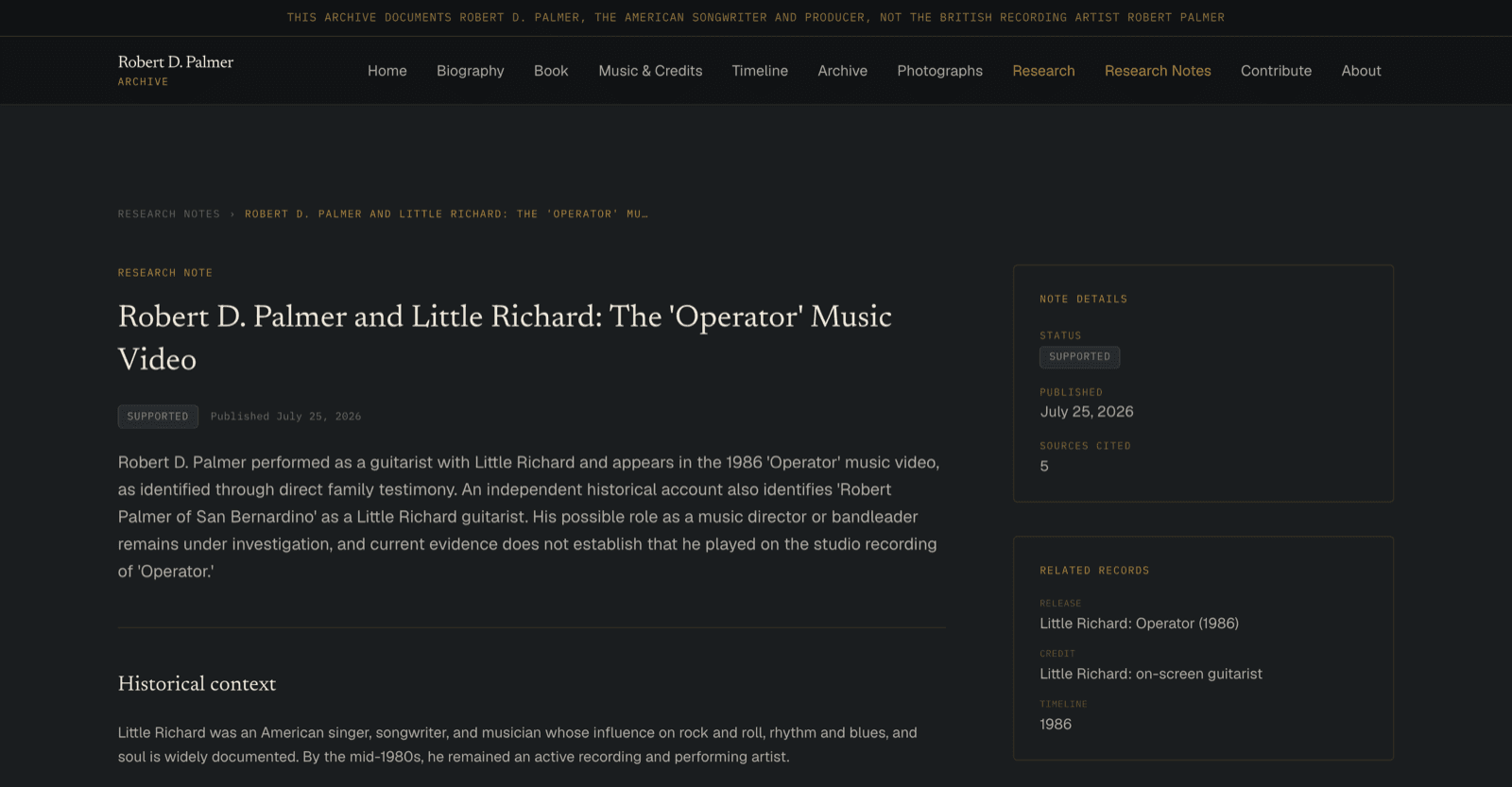
Some claims could be verified against multiple independent sources. Others couldn't. A few were flatly unresolved: family testimony placed Robert performing with Little Richard in a 1986 music video, and an independent historical account corroborated his presence, but no source establishes whether he played on the studio recording or held a music-director role. The archive states this directly, rather than rounding it up to a confirmed credit.
Identity was its own problem. Compositions registered under a stage name needed to be confirmed as Robert's before they could be added to the catalog at all, and one title overlapped with a same-named song by an unrelated recording artist who happens to share his surname, a namesake conflict that recurs throughout the research and has to be actively checked for, not assumed away.
Before this work, none of that had a shared structure. The material lived across disconnected formats and locations, with no consistent way to tell what was confirmed, what was recollection, and what was still open. That gap, not a lack of material, was the actual problem to solve.
The Decisions Made
An evidence-first information architecture replaced what would traditionally be a straightforward biography. Confidence and evidence status were built into the structure itself, not layered on as a caveat, so uncertainty stays visible instead of getting smoothed into one confident narrative.
None of this was decided once and then executed. Sources kept surfacing after launch, some confirming what was already published, some contradicting it, and each one had to be judged on its own before anything changed.
From Evidence to Decision
| Evidence or uncertainty | Judgment made | Action taken | Reasoning |
|---|---|---|---|
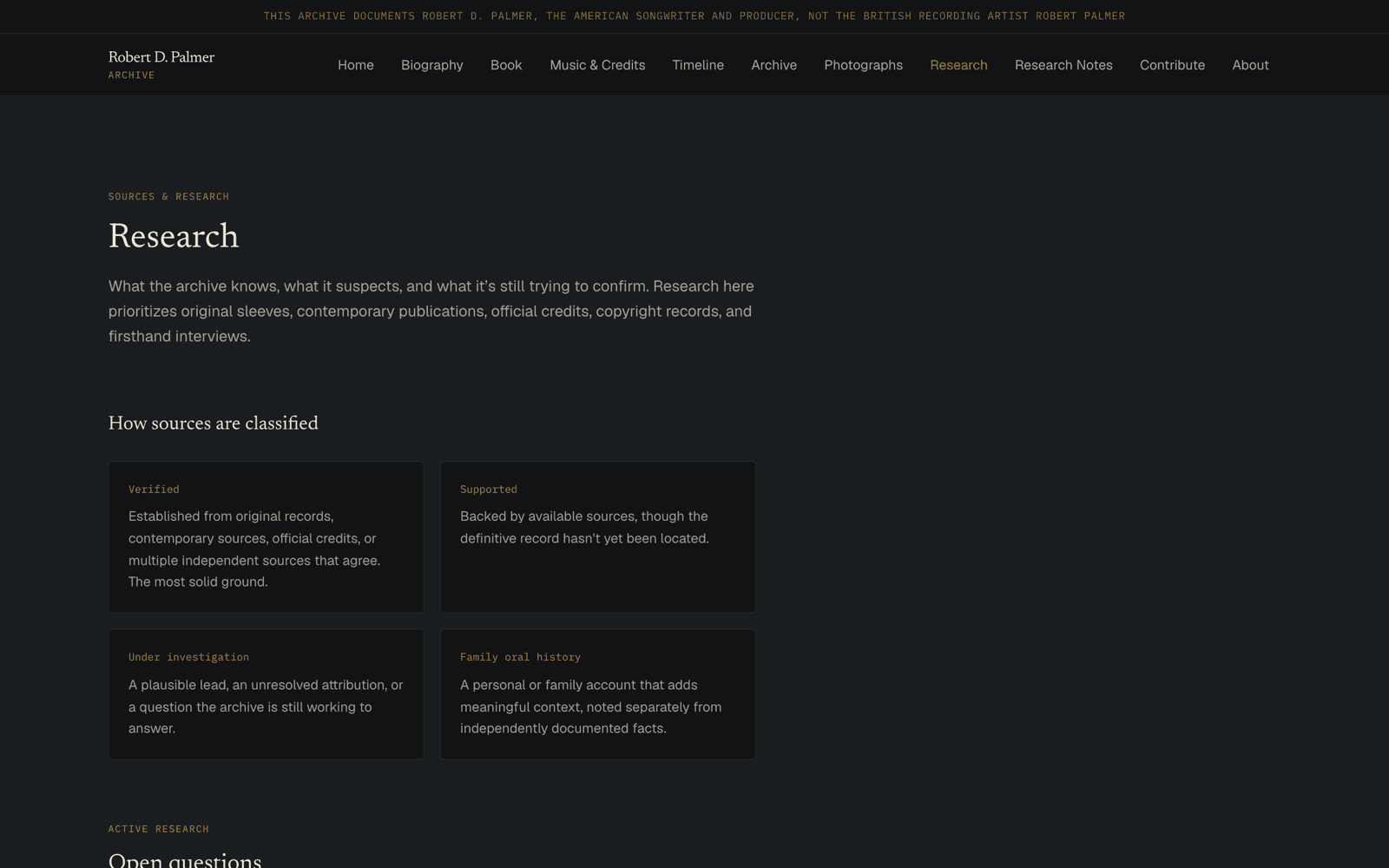
| Claims came from sources of very different reliability: original credits and royalty records versus family recollection versus fan-run discography sites. | Reliability isn't binary. It needed more than one category between "confirmed" and "unconfirmed." | Built a four-tier status system, Verified, Supported, Under investigation, and Family oral history, applied to every credit, composition, and research note. | A single confirmed/unconfirmed split would have either overstated shaky claims or buried well-supported ones next to pure speculation. |
| A royalty statement confirmed Robert's registered interest in certain compositions, but those titles overlap with existing songs by an unrelated artist who shares his surname. | A shared title is not shared authorship. Attribution needed independent confirmation before publication, not an assumption from the name match. | Withheld release-level attribution on the overlapping titles pending further comparison, and marked the entries as unresolved rather than silently including or excluding them. | Publishing a wrong attribution would have been worse than publishing an open question. An identity error is exactly the kind of mistake that spreads once it's public. |
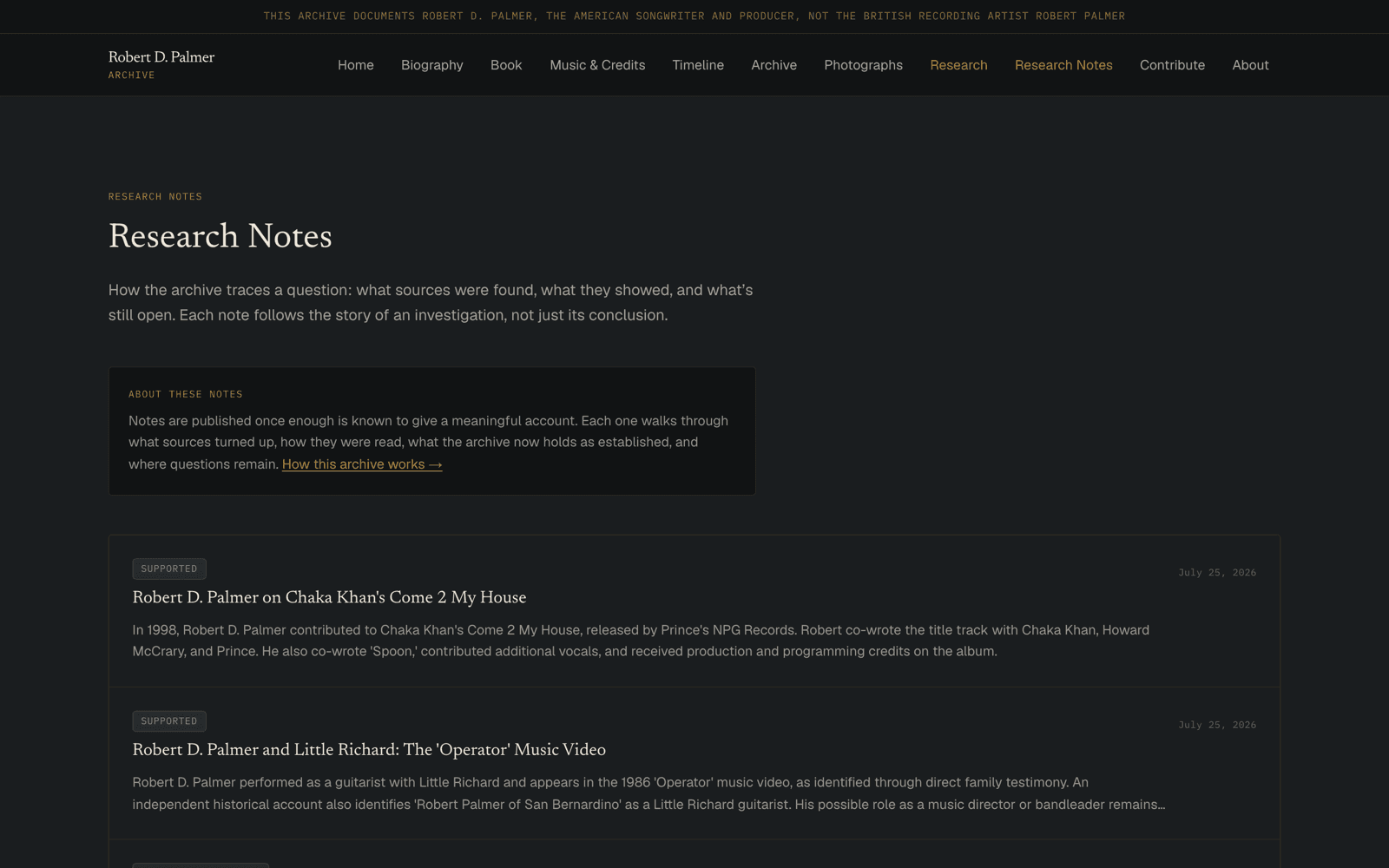
| Family testimony and one independent historical account both placed Robert performing with Little Richard in a 1986 music video, but neither source confirms his specific role or whether he played on the studio recording. | The appearance is well-supported. The specific role is not, and the two shouldn't be reported at the same confidence level. | Published the appearance as "Supported" while stating explicitly, in the research note itself, that his role remains under investigation and that current evidence does not establish he played on the studio recording. | Separating what's solid from what's still open lets the record stay useful without waiting for a final answer that may never come. |
| A contemporary trade-press feature contains a period photograph placing Robert within an early group, exactly the kind of primary source the archive prioritizes. | A source can be strong evidence without being publishable material. | Cited the photograph as a source and described what it shows, but withheld the image itself pending rights clearance, rather than publishing it and asking permission later. | Treating rights clearance as a precondition for publication, not a follow-up step, matters more, not less, when the subject is a family member. |
| Open, unresolved questions (where surviving footage might be, what an exact date was) don't disappear just because the narrative pages need to keep moving. | Unresolved questions needed a permanent, visible home, not a footnote that gets cut in editing. | Created a dedicated Research Notes and open-questions structure, ranked by priority, that stays live and separate from the narrative pages. | If open questions only exist in an editor's head, they get lost. Written down and ranked, they can actually be pursued, and anyone can see what's still missing. |
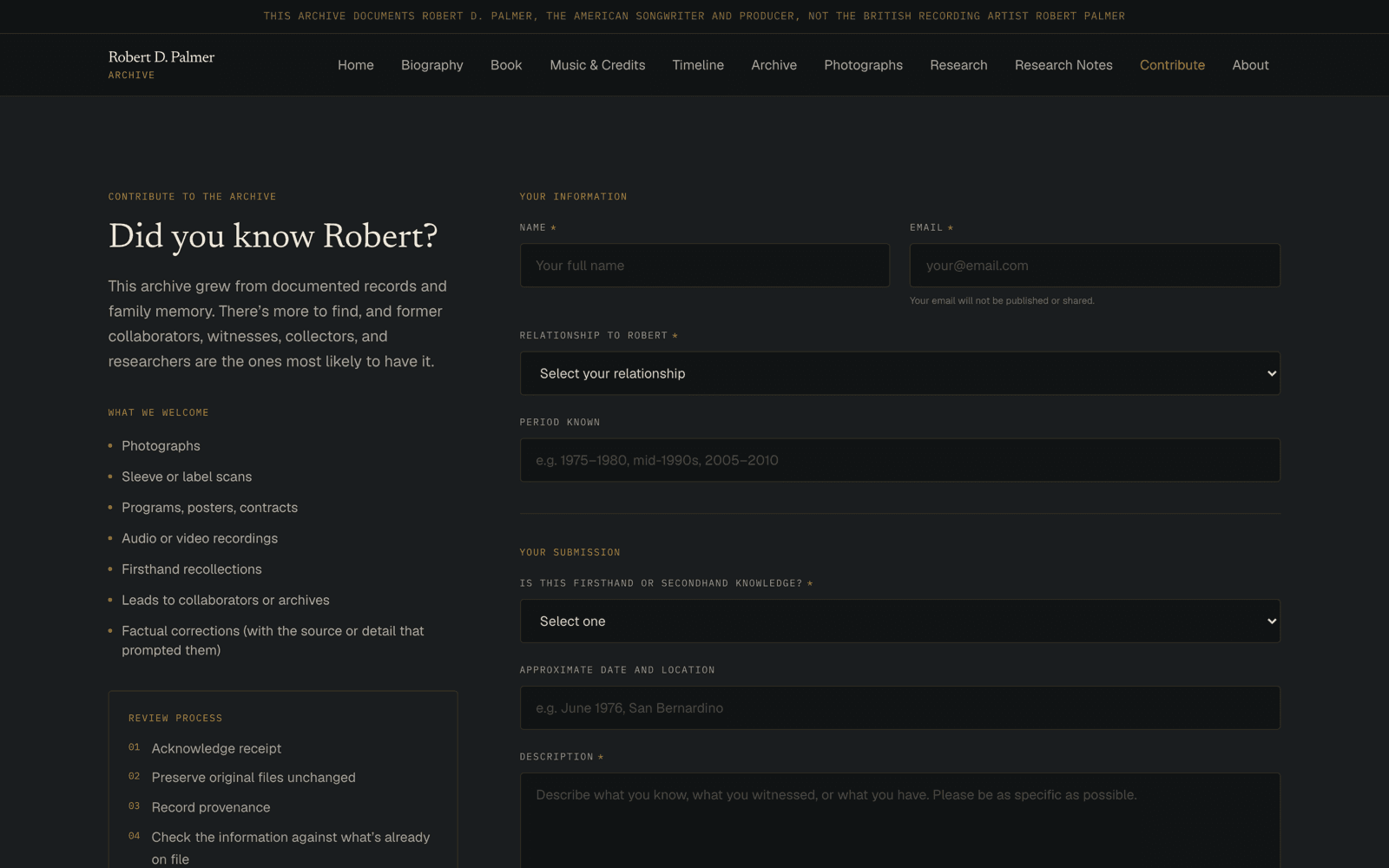
| The people most likely to have missing material, collaborators, family, researchers, vary in how reliable their memory is and in whether their material can be shown publicly. | Contribution and publication are two different questions, and asking for both at once would discourage the first. | Built a contribution workflow that separates submission from display: every submission is acknowledged, original files preserved unchanged, provenance recorded and checked against the existing record, and written display permission obtained separately before anything is published. | Someone should be able to hand over a photograph or a memory without also having to decide, on the spot, whether the world gets to see it. |
The System Created
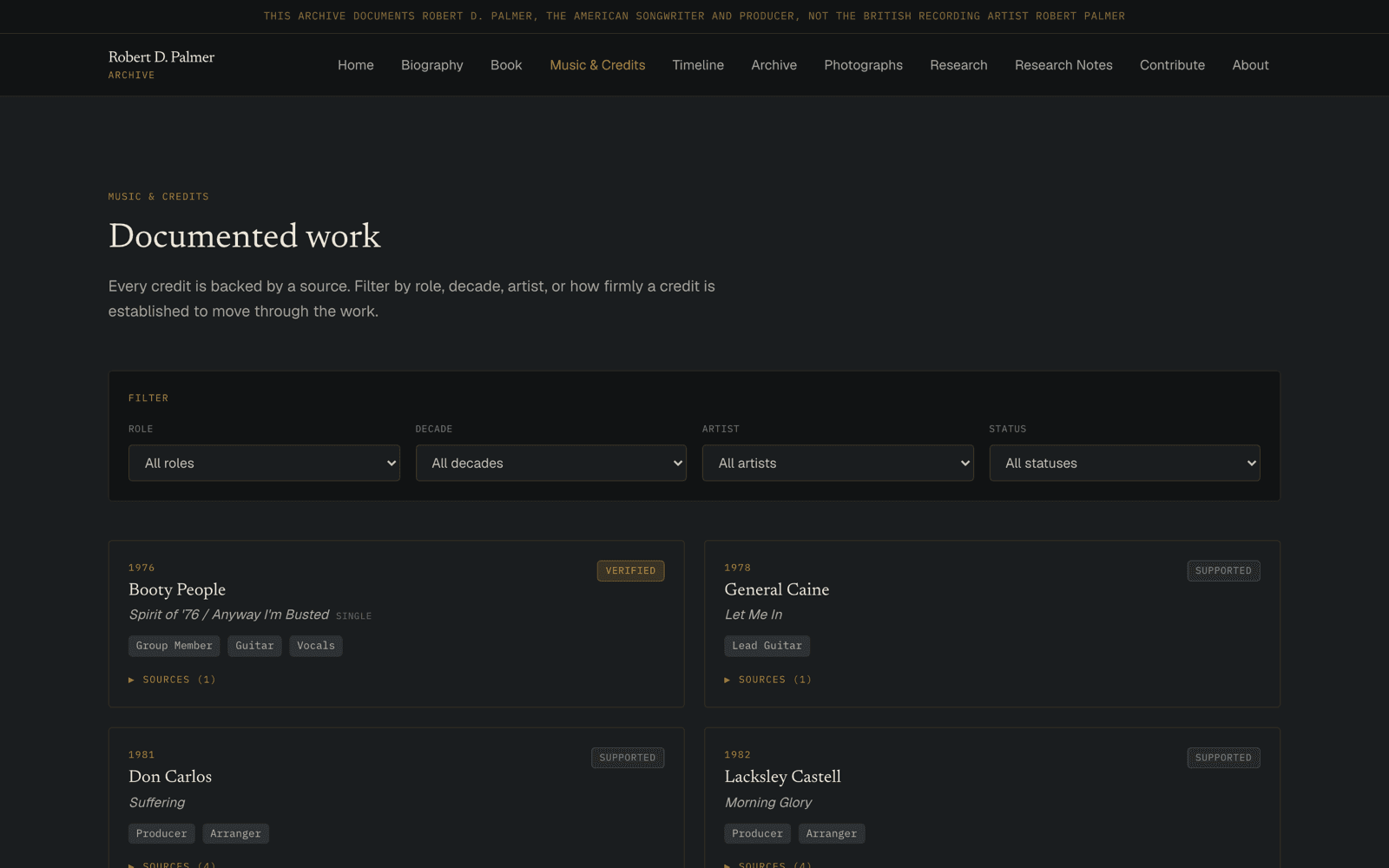
The result is a live public archive organized around evidence rather than chronology: a biography and timeline for the narrative throughline, a Music & Credits section where every entry carries a status tag and its supporting sources, a Research page that documents open questions and explains exactly how sources are classified, Research Notes that publish individual investigations as they resolve, and a Contribution workflow for people with more to add.
AI was used as a thinking partner throughout: drafting, structuring information, and pressure-testing assumptions about how the material should be organized. Every historical claim and every organizational decision was reviewed before publication. AI accelerated the thinking. It didn't make the calls.
Role and Constraints
I did the research, information architecture, content organization, content design, project direction, and implementation myself. AI tools supported drafting and structuring; every historical claim and organizational decision was reviewed by me before publication. Public records, the completed memoir, and family recollection all supported the work, but the judgment calls belonged to me.
The real constraints weren't budget or a client timeline. They were fragmented and sometimes conflicting records, the emotional proximity of researching my own father's life, privacy and permission concerns around family material and images that weren't cleared for public display, and the need to keep the archive readable and human without ever presenting a guess as a fact.
The Tangible Result
No quantitative performance metrics were collected for this project. What exists instead is the work itself:
- →A four-tier confidence and evidence status system applied across credits, compositions, and research notes
- →A Research Notes section publishing individual investigations as they resolve
- →A Research page documenting open questions, source classifications, and what the archive can't yet confirm
- →Records corrected and clarified, including credits withheld from publication pending identity confirmation
- →A contribution workflow separating submission from public display permission
- →A biography, timeline, and credits structure organized around evidence rather than a single chronological account
- →Six live, distinct archive sections: Biography, Timeline, Research Notes, Music & Credits, Media, and Contributions
What the Project Taught YX Lab
Balancing storytelling with historical accuracy wasn't a decision made once. It came up throughout the project and had to be judged case by case, especially where sources disagreed and no single account could be treated as definitive.
The broader lesson now shapes how YX Lab approaches any research-heavy engagement: build the system to hold uncertainty before building the narrative on top of it. A confidence and evidence structure has to exist from the start, not get retrofitted once the first contradiction shows up.
The archive isn't finished. It's built to keep taking verified material, corrections, and contributions over time, rather than treating launch as a closed, final document.
Closing
Trust does not require pretending everything is certain. It requires making the boundary between evidence, memory, and open questions visible.
That's the standard this archive was built to meet, and it's the standard YX Lab now carries into every project where the material is incomplete and the stakes are real.
View the live archive→Working through something similar, or just want to compare notes?
Start a conversation